
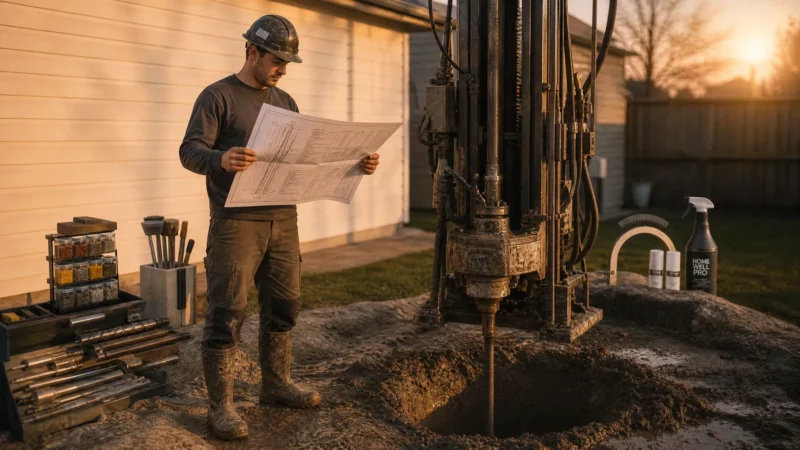
Oregon’s Deep Wells Reveal a Surprising Infrastructure Challenge
Drilling deep wells in Oregon and California presents unexpected challenges beyond the initial dig, involving complex geology, budget discipline, and ongoing.
Oregon and California have a habit of making simple infrastructure look romantic until you try to drill through them. A well sounds like a clean answer to a water problem, then the rig arrives, the ground turns unpredictable, and the job becomes a test of geology, patience, and budget discipline.
That is the part most owners do not see coming. The well itself is only half the story. The other half is everything that has to work afterward, from pump sizing to testing to the ugly reality that one bad summer can turn a quiet property into an emergency repair site.
The real work starts below ground
Water well drilling is sold as a path to independence, and that is true, but the path runs through soil, rock, depth, permits, and a lot of uncertainty. A property may look ideal on the surface and still demand a deeper bore than anyone hoped. In some cases the first obstacle is not water at all, but hard stone, shifting ground, or conditions that force the crew to change approach mid job.
Enloe Drilling and Pumps, Inc. has lived inside that reality for over 100 years. The company started in 1913, when Clarence Enloe brought a steam powered cable rig back to his homestead near Bend, Oregon and drilled the family’s first well. Four generations later, the business is still operating in Oregon and California, which tells you something useful about the work. This is not a field that rewards shortcuts.
Why drilling matters to homeowners and operators
A private well changes the operating model of a property. Instead of depending on a municipal line, you own the water source and the maintenance burden that comes with it. For homes, farms, and commercial sites, that trade can be worth it, but only if the drilling is done with enough precision to avoid expensive surprises.
The strongest case for The Unexpected Realities of Drilling a Water Well for Your Home 🧩 Obsession Factory is not the sales pitch. It is the list of frustrations that sit behind every call for service: an uncertain water table, a budget that keeps growing, a pump that dies in the middle of summer, and the kind of ground that laughs at assumptions.
Water well drilling benefits that actually matter
Professional water well drilling earns its keep when the hole in the ground becomes a long term asset instead of a recurring problem. The main benefits are blunt.
- Access to a dependable underground source instead of relying on outside supply.
- A system that can be designed around residential, agricultural, or commercial demand.
- Better control over long term water costs.
- A property specific setup that can match local conditions rather than forcing a generic solution.
- A route to greater self sufficiency in rural or remote locations.
The practical part is even more important. A good drilling team uses site assessment, casing, and well development to build a supply that holds up over time. That matters in places with mixed geology, because Oregon and California can make two properties a mile apart behave like different planets.
Pump installations are where a lot of projects win or fail
A drilled well without a sound pump system is just expensive optimism. Pump installation and repair determine whether the water actually gets from the aquifer to the tap without wasting energy or tearing up the schedule.
- Efficient extraction, which keeps water moving without making the system work harder than it should.
- Less downtime, especially when an aging pump is replaced before it fails completely.
- Better pressure and more stable delivery for daily use.
- Maintenance flexibility, because repair work can extend the life of an existing setup.
- Cleaner integration with new or existing well infrastructure.
That is why pump work is not an afterthought. In the real world, a summer failure is the moment everyone remembers how much they disliked ignoring maintenance.
A multigeneration company has a different edge
Enloe’s longevity is not just a marketing detail. Clarence Enloe’s son Don, known as Grandpa, drilled wells in Siskiyou County after moving to Washington during World War II, then started drilling in Mt. Shasta in 1946. One of his jobs there was a municipal well that artesianed at more than 1000 gallons per minute. That kind of project is the opposite of a brochure story. It signals range, not polish.
The company’s current service list reflects that same practical spread. It includes water well drilling, pump installation and repair, agricultural and domestic wells, geotechnical drilling, water well testing, and residential water wells. The stack is built for people who need water, not for people who want to talk about water.
Where the service menu fits
For builders, landowners, and operators, the most useful way to think about these services is by outcome.
- Water well drilling delivers the source.
- Pump installation and repair make the source usable.
- Agricultural and domestic wells tailor output to the demand pattern.
- Geotechnical drilling helps assess ground conditions before a larger build.
- Water well testing checks yield, quality, and overall performance.
- Residential water wells package the whole setup for household use.
That structure matters because the service boundary is not clean. A homeowner may think they need a drill hole. The real need might be a full system, plus testing, plus a pump upgrade that stops the next failure before it starts.
FAQ
How much does it cost to drill a water well?
The price depends on depth, rock or soil conditions, site location, and the equipment needed. In the United States, a basic project can run from a few thousand dollars to far more if the job is deep or technically messy. A site specific quote is the only sensible starting point.
How deep does a water well need to be?
There is no universal depth. The right number depends on local groundwater conditions, the water table, and what the site assessment shows before drilling begins.
How long does it take to drill a water well?
It varies with depth, geology, weather, and the amount of setup needed around the job. A straightforward hole moves fast. A difficult one does not.
Why does pump installation matter so much?
Because a well only helps if the pump can move water reliably. Poor sizing, worn components, or sloppy installation can turn a solid well into a weak system.
Do I need water well testing after drilling?
Yes. Testing for yield, water quality, and overall performance helps confirm that the system can handle real use over the long term.
What people usually miss
The cleanest well projects are the ones where nobody had to guess too much. That usually means a team that can handle consultation, permitting, drilling, and pump installation without bouncing the homeowner between different contractors. It also means treating the job as a system, not a single hole in the ground.
Enloe’s contact numbers, 530-964-2807 and 541-841-4124, sit on the same page as its service promise for a reason. This work still depends on humans who know how to read a site, respond when conditions shift, and fix the parts that fail after the excitement has worn off.